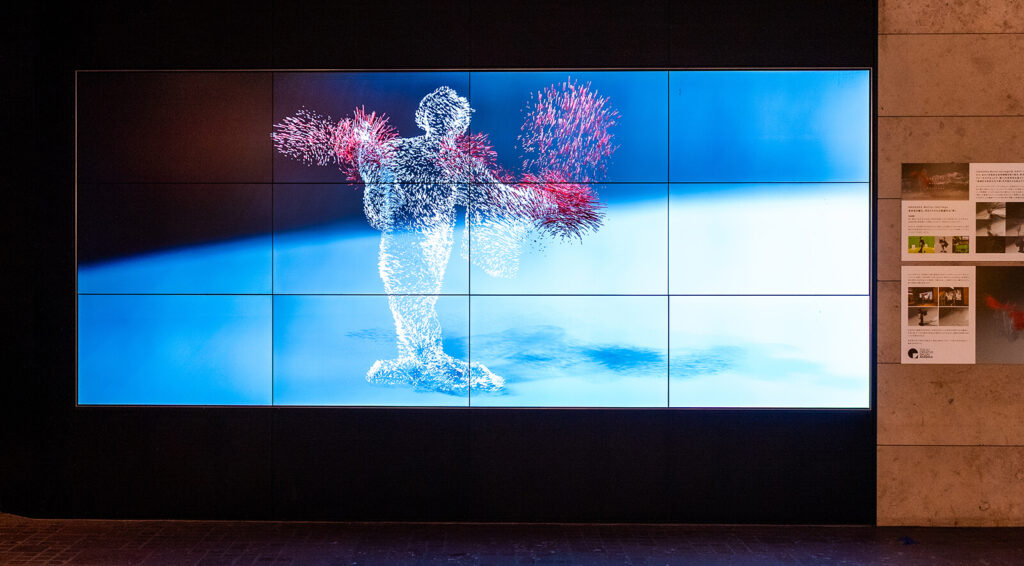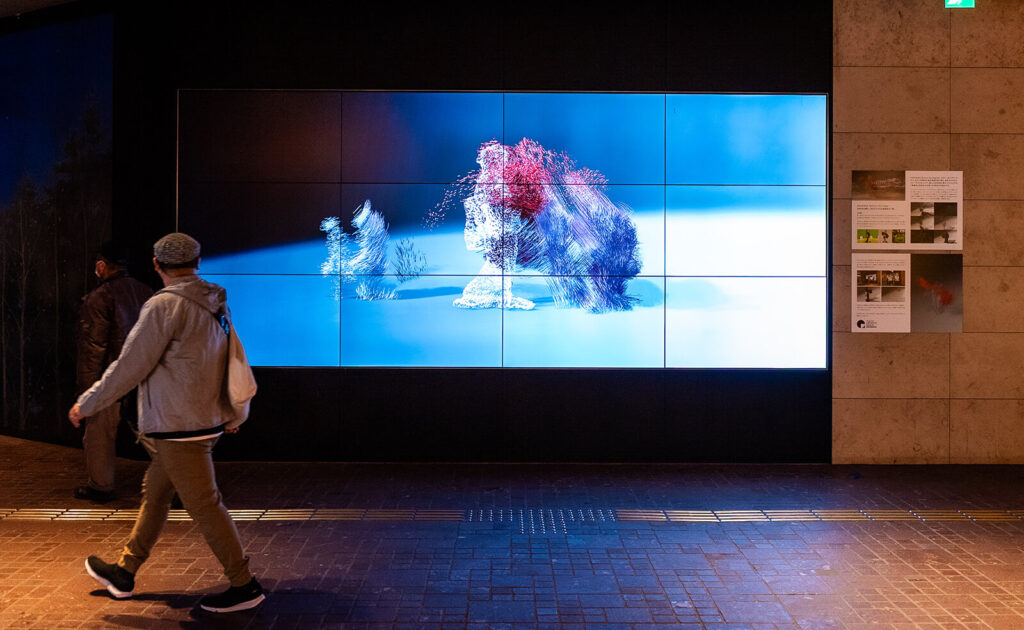


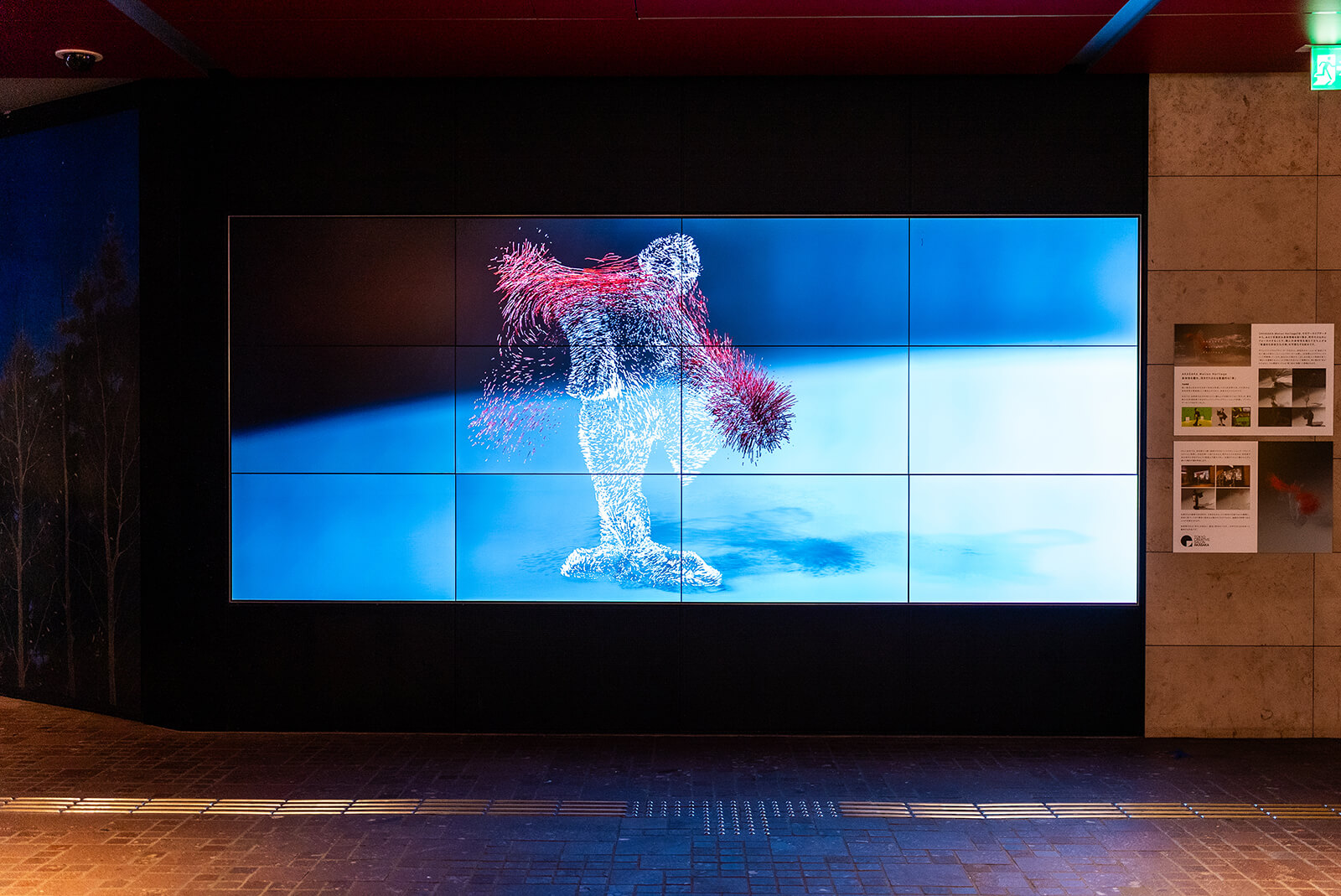
AKASAKA Motion Heritage is an attempt to visualize the “universal beauty of Akasaka culture” that emerges beyond individual physicality, by intentionally removing realistic bodily information from archive data and focusing on the movements themselves.
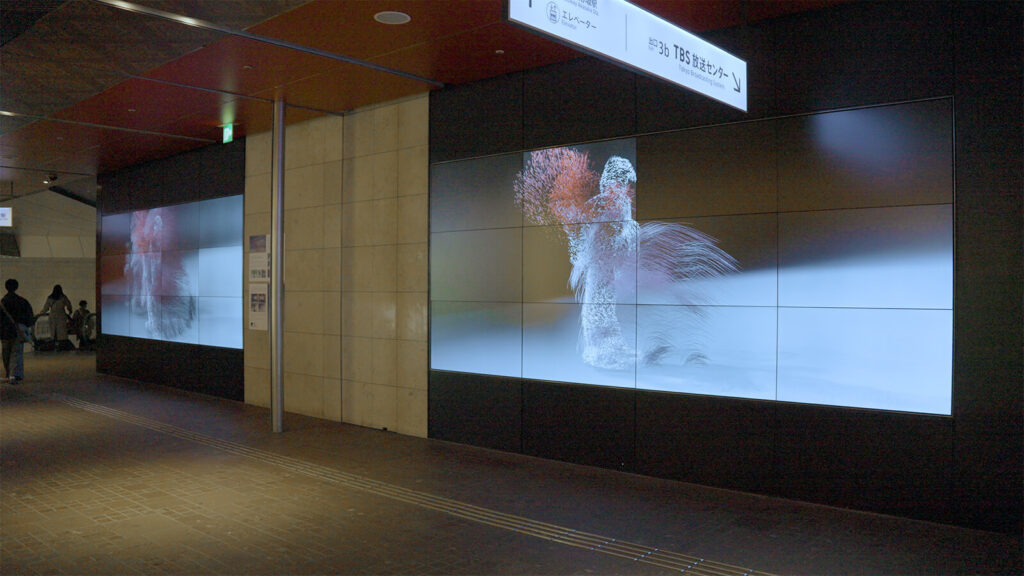
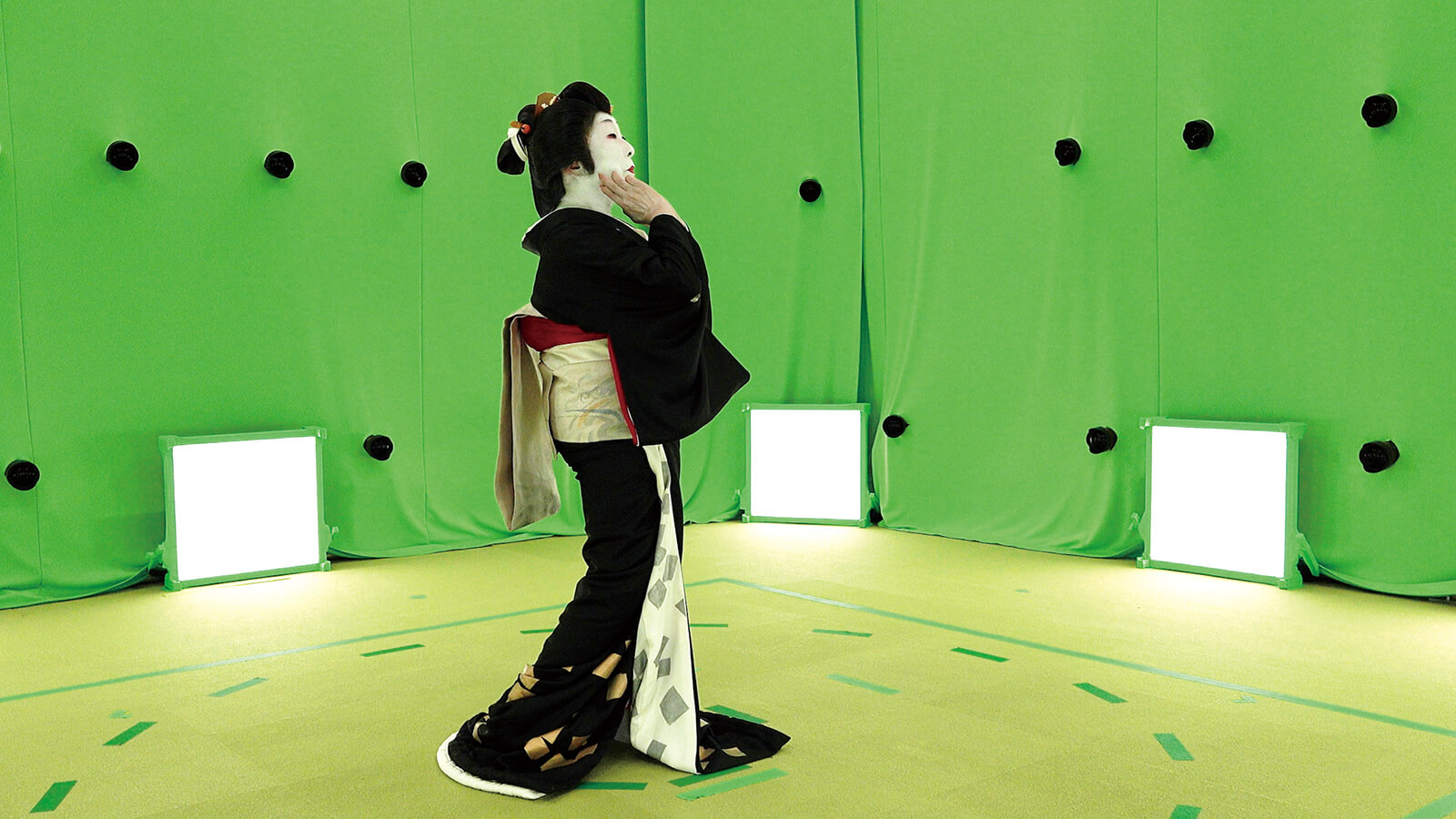
Ikuko Akasaka has long embodied the rich history and social culture of Akasaka. Her movements, honed to the pinnacle of her craft as a renowned geisha, are the very essence of Akasaka’s heritage. In this work, the shosa (traditional gestures) that Ms. Akasaka has refined over 60 years were recorded and digitally archived using volumetric capture, a cutting-edge 3D measurement technology.
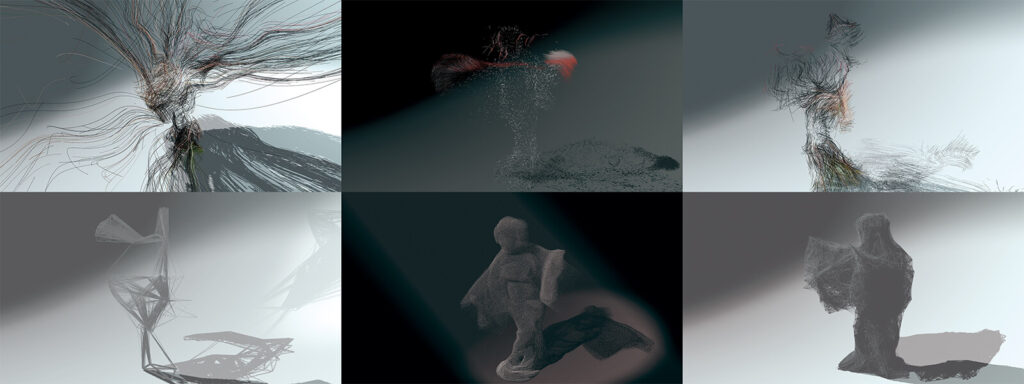
Based on the captured data, Ms. Akasaka’s motions are decomposed into parameters such as speed, direction, and the shifting center of gravity, then reconstructed as graphics within a 3D space. These extracted movements are visualized through techniques such as connecting points, tracing trajectories, and accumulating layers. This transforms the experience from merely “viewing” a movement into “sensing” its underlying structure and rhythm.
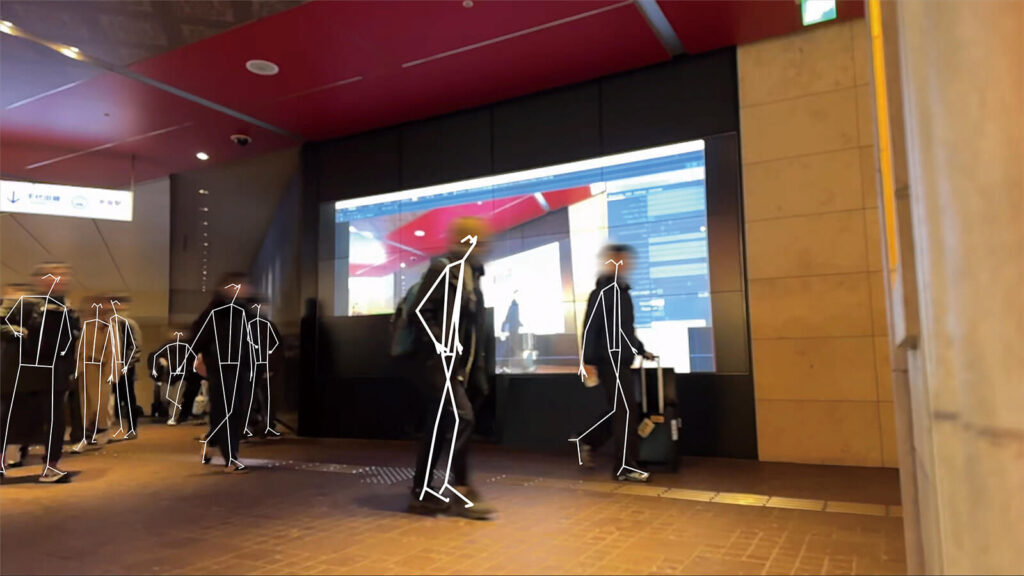
Furthermore, the work captures real-time motion data from people walking through the passage from Akasaka Station, integrating them into the artistic space. The steps of modern passersby overlap on screen, echoing Ms. Akasaka’s shosa and forming new layers of movement guided by the rhythms of tradition.
At the intersection of these symbolic traditional gestures and the bodies of people in their daily lives, it becomes clear that Akasaka’s history and its present are not fragmented, but a seamless continuum of time.
Starting from the shosa of Ikuko Akasaka, this work connects history with the present, passing the town’s culture on to the future.
Key Points
Pre-processing Data
Our goal for the visual expression of this work was to create an intersection between the reconstruction of archived shosa and the real-time tracking of passersby within a digital space.
The archived 3D data initially consists of a sequence of meshes where the topology changes frame by frame. To transform this into a continuous trajectory of movement, we applied a specialized pre-processing stage. Using Houdini, we conformed the original motions into a consistent mesh structure, reconstructing the data to maintain temporal consistency. This process enabled us to extract continuous motion parameters—such as the velocity and direction of individual body parts—that would be nearly impossible to obtain from raw, unoptimized data.
For the management and rendering of these vast archives, we utilized POPs (Point Operators) within TouchDesigner. By leveraging this feature to efficiently process massive point clouds on the GPU, we achieved a streamlined implementation that maintains high performance while faithfully capturing and expressing the subtle, nuanced behaviors of the extracted shosa.
Interactive camera movement
We constructed a system in which the movements of people passing in front of the signage are streamed from smartphone cameras via NDI and converted into abstract motion data through real-time Body Tracking. By dynamically transforming this real-time movement based on parameters generated from the archived data, we aimed to create a visual shift that feels as though the viewer’s own motions are being drawn into the fluid rhythm of Ms. Akasaka’s shosa.
This dynamic process—where the trajectories extracted from passersby are rewritten in sync with the rhythm of the archives—is implemented as a sophisticated real-time simulation.
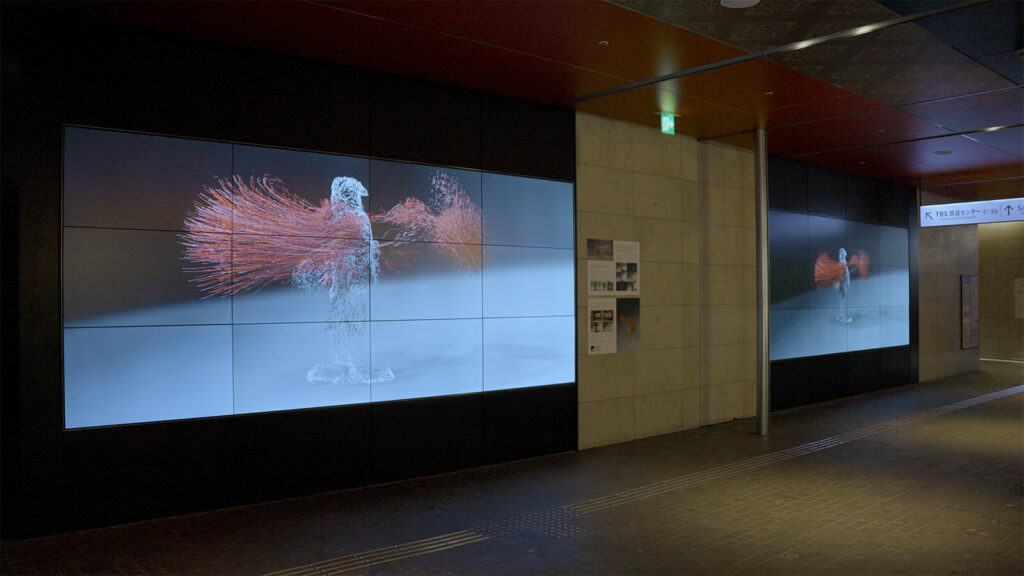
Given its location in a passage connecting to Akasaka Station, the space experiences recurring cycles of high and low pedestrian traffic. We designed the system to zoom out when the crowd density is high, capturing the visual intersection where the real-time movements of passersby meet the archived shosa of Ikuko Akasaka. Conversely, when there are fewer passersby, the camera zooms in on Ms. Akasaka’s motion data, focusing the viewer’s attention on the purity and refinement of the shosa itself.
By dynamically adjusting the camera work in response to these fluctuations in pedestrian flow, we sought to incorporate the natural rhythm of Akasaka into the rhythm of the artwork, allowing the pulse of the city to define the visual experience.