


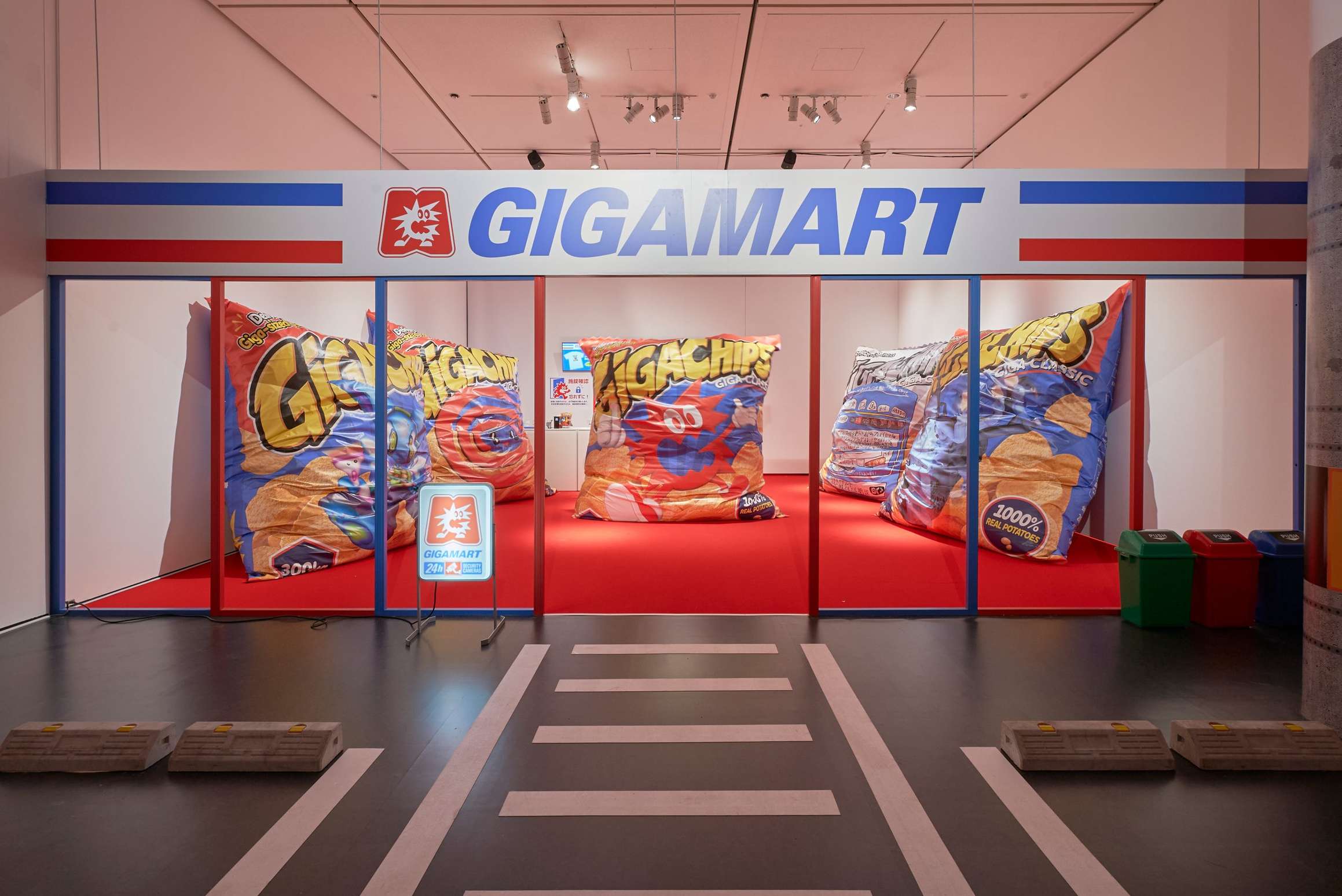
“GIGAMART Exhibition,” an experiential exhibition held at Azabudai Hills Gallery.
For this project, we were responsible for planning and production, with a primary focus on experience design, development of the camera-based “TOH” system, and overall production management.
The exhibition takes place in “GIGAMART,” a fictional convenience store.
The project was developed under the theme of “Conveni Alternative,” which explores new possibilities for Japan’s uniquely evolved convenience-store culture by viewing it as a form of cultural IP.
Building on the lineage of the “TOH” series, the project was developed by the creative team behind the previous works, together with a diverse group of creators, based on an original concept by rapper and creative director TaiTan.
Products and advertisements filling every corner of the store, an endless stream of collaborations, highly optimized product displays, and a space that continues to absorb new services and forms of entertainment.
By exaggerating and reinterpreting these distinctive characteristics of Japanese convenience stores through the ideas of “GIGA / Giga”—or caricature, we sought to dismantle the relationships between consumption, products, and advertising that we unconsciously accept in everyday life, and reconstruct them as a new spatial experience.
The exhibition featured a range of experiences, including oversized “GIGA Potato Chips,” a camera-based version of “TOH” in which visitors steal products while evading the gaze of surveillance cameras, and a shop where visitors could purchase original GIGAMART products and collaboration merchandise.
Touching an oversized product, “stealing” a product, and ultimately purchasing one. By shifting the ways in which visitors interact with products, we created a spatial experience that invites them to physically reconsider the everyday act of consumption.
Key Points
Building the World of GIGAMART by Integrating Space and Experience
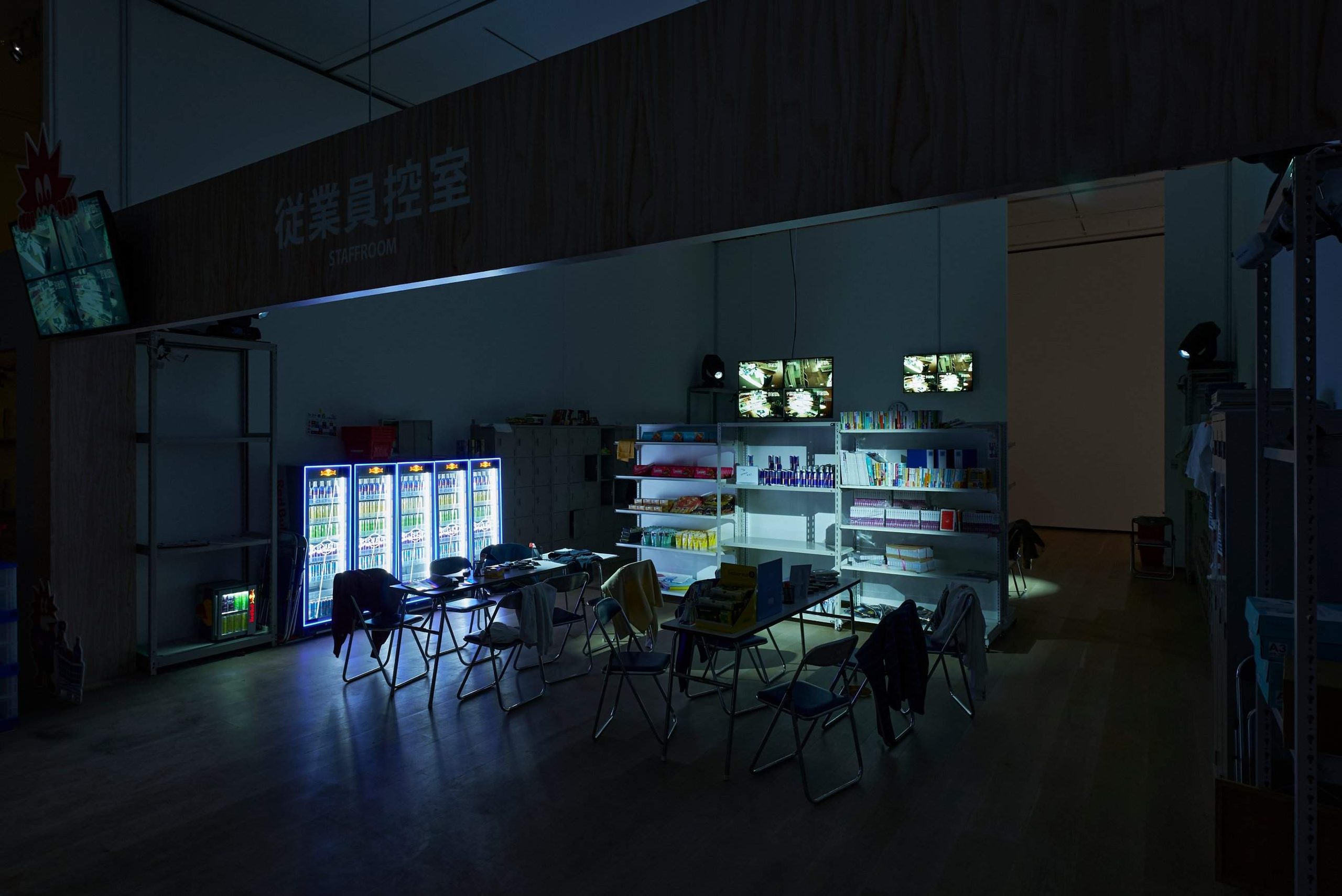

Rather than creating an exhibition space in which individual pieces of content were simply placed, we focused on making the fictional convenience store GIGAMART feel like a complete world in its own right.
To shape that world, we looked closely at the many elements that make up a convenience store—from sales floors, shelves, advertisements, and signage to backrooms, loading areas, and surveillance equipment.
Together with creators working across spatial design, graphics, merchandise, technology, and other disciplines, we developed each element from the perspective of “How would this exist inside GIGAMART?”
While familiar convenience-store elements were exaggerated through the lens of “GIGA / caricature”—from oversized products to excessive advertising—we also designed spaces beyond the storefront, including storage, logistics, and management areas. This allowed the venue to feel less like a set and more like a store that could genuinely exist.
Rather than placing content inside a space, we first established the world itself, allowing content and experiences to exist naturally within it.
This was the fundamental approach behind the spatial design of GIGAMART.
Experience Design and Development of the Camera-Based “TOH”
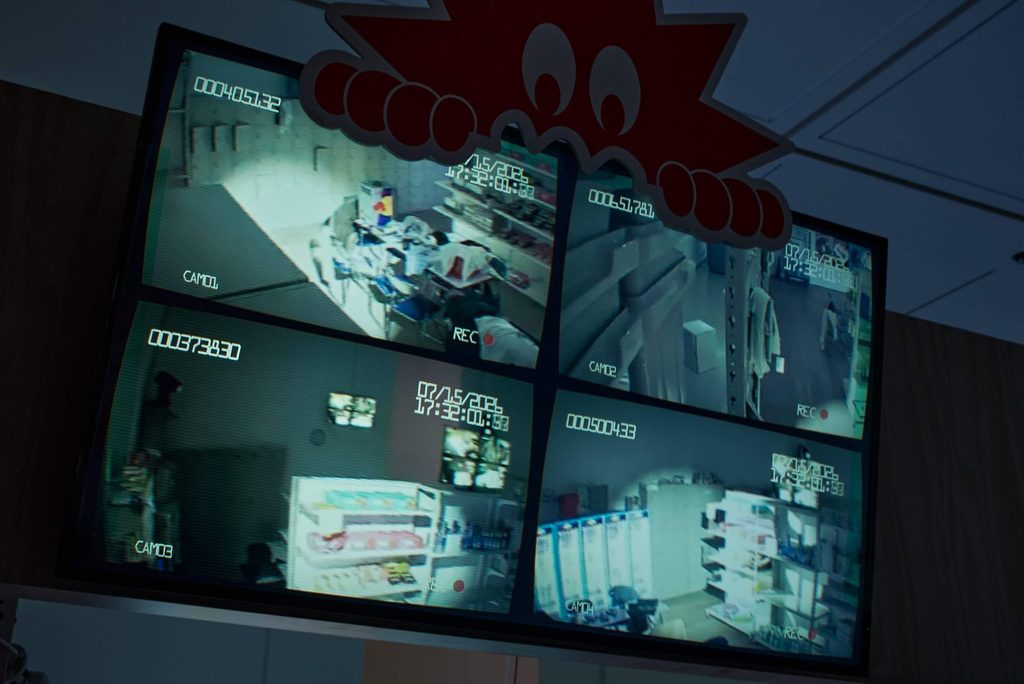
One of the central experiences of the exhibition was built around a simple premise:If the cameras don’t catch you, you can steal anything in the store.
The original “TOH” project used an equally simple rule—“Do not make a sound.” That single restriction transformed the way participants walked, positioned their bodies, and even carried objects.
For GIGAMART, we evolved that structure by changing the rule to: “Do not let the surveillance cameras recognize you as a person.”
Using footage from multiple cameras installed throughout the venue, we developed a system that uses AI-based person detection to track participants in real time.
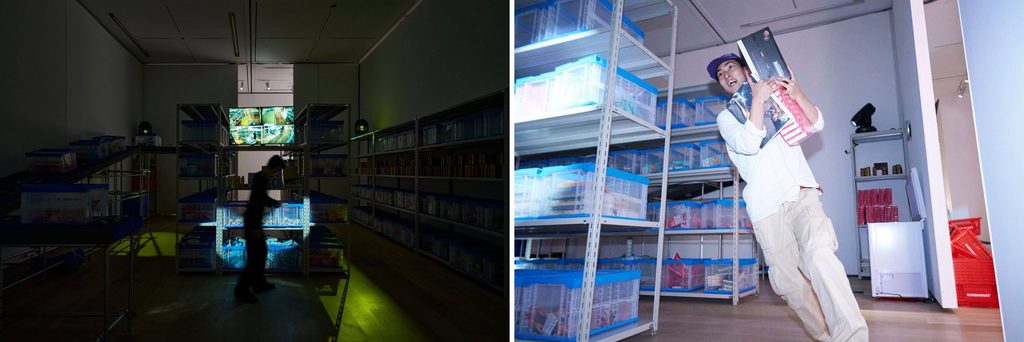
At the same time, we deliberately avoided creating a game with one predetermined solution, leaving room for participants to discover their own ways of playing.
Some searched for camera blind spots. Others crouched down, changed their posture, or used shelves and products to obscure their silhouettes. Different participants naturally developed different strategies, while watching others play led to new techniques being discovered and passed on to the next players.
For this reason, development involved more than simply tuning the accuracy of the AI. Camera positions and angles, fixture and product placement, and the sensitivity of the detection system were all adjusted together.
Through repeated on-site testing, we searched for a balance where the experience was not too easy, but could be overcome through ingenuity.
Rather than presenting a single correct solution, we created a simple rule and environment from which participants could generate their own actions and strategies.
In this way, we designed an open-ended experience through both spatial and technological approaches.
Cross-Disciplinary Production from Concept to Implementation
Rather than determining a fixed final form in advance and assigning separate tasks to each production team, this project was developed through a process in which specialists from different fields worked in parallel and continuously evolved the concept together.
By sharing questions such as “What makes something feel like GIGAMART?”, each team contributed its own perspective as the concept became increasingly concrete.
Our role was to connect the different production teams and translate the concept into space, experience, and systems, overseeing the process through to implementation.
Ideas generated during production were fed back into the concept itself—leading us to modify spaces, change rules, and adjust systems along the way.
Through this iterative process, our goal was not to create a collection of individual outputs, but to integrate them into one coherent world called GIGAMART.